Sunday, February 26, 2017
The Oscars vs. The O'scars
My thoughts on just a few of the categories up for grabs tonight:
Best Picture Nominees: Arrival, Fences, Hacksaw Ridge, Hell or High Water, Hidden Figures, La La Land, Lion, Manchester by the Sea, and Moonlight
I did not see Fences, Hacksaw Ridge, or Hidden Figures, so I cannot comment on these films. However, Manchester by the Sea, La La Land, and Hell or High Water were numbers five, four, and three, respectively, on my 2016 O'scar List ©™. Sadly, neither of my top two, Love and Friendship and Sing Street, were nominated.
I recently watched Moonlight, which some critics believe is chasing La La Land for the Oscar. While I found it to be a well-made film, after Moonlight ended, I felt as if the film were unfinished...not so much in the sense that I wondered what happened after the credits, but that the story seemed to be only partly told throughout the film. I wish the characters had been explored more fully (more about that below). As much as I liked La La Land and Manchester by the Sea, I believe that among this list of movies, Hell or High Water deserves the Oscar. The characters are fascinating and life-like, the story speaks to the times we live in, and Jeff Bridges is so solid in his role as the gritty Texas Ranger.
Best Actor Nominees: Casey Affleck (Manchester by the Sea), Andrew Garfield (Hacksaw Ridge), Ryan Gosling (La La Land), Viggo Mortensen (Captain Fantastic), Denzel Washington (Fences)
On principle, because I hated Captain Fantastic so much, I reject Viggo Mortensen's nomination. However, I do love Viggo in just about everything else. I did not see Garfield or Washington's films, so I cannot judge. I very much hope that Casey Affleck wins for Manchester by the Sea. I believe that this film makes him The Greatest Affleck. He was perfect for the role, and played all its emotional complexities with precision. Gosling shined in La La Land, but falls short of Affleck in this category.
Best Supporting Actor Nominees: Mahershala Ali (Moonlight), Jeff Bridges (Hell or High Water), Lucas Hedges (Manchester by the Sea), Dev Patel (Lion), Michael Shannon (Nocturnal Animals)
First off, Jeff Bridges probably ought to be in the Best Actor category. But he's not, and so, in this category, he should triumph. His performance is, by far, the best of the year. Though I didn't see Michael Shannon's film, he is always good, so I don't doubt he belongs. Patel and Hedges were both very good. Hedges, a young and relatively inexperienced actor, should get extra points for his excellent work. Mahershala Ali's best work has been in Netflix's House of Cards, as the lawyer and lobbyist Remy Danton. He does a very nice job of inhabiting the "drug dealer with a heart of gold" character in Moonlight. He plays it with a sensitivity and complexity that the role deserves. But there just wasn't enough of the character in the film. Perhaps if there had been more Ali in this picture, it would be a different story as to this category. However, in my mind, it would be hard for anyone to equal Bridges' work in Hell or High Water.
Best Song or Best Original Score:
To not nominate Sing Street in either of these categories is a crime. Check it out. That said, La La Land should be a shoo-in for everything musical.
Thursday, January 12, 2017
2016 at the Movies: A Retrospective
Ever since I was a little boy, my father and I have gone to the movies. Thanks to him, I have a love of great cinema. Here are the totality of my thoughts on this year in film, as posted on Facebook:
That's right folks, it's almost time for the 6th Annual O'scars...my list of the top films of the year. 2016 was a pretty good year for film. I saw 47 theatrically released films. Most were at least "aight" and 13 were top-notch.
A Special O'scar for Weirdest Movie of the Year: THE LOBSTER
Colin Farrell is a talented actor...and thank goodness he is, because The Lobster is absolutely bizarre. From the ridiculous plot to the intentionally stilted dialogue, this film challenges the viewer to keep watching. I stuck it out to the end, though I don't know if I can say that was rewarding. I enjoy "weird"...but I sometimes thought this film was weird merely for weird's sake. If there was a higher purpose, it escaped me. But it had John C. Reilly in it, so...REDEMPTION.
A Special O'scar for My Guilty Pleasure of 2016: MIKE AND DAVE NEED WEDDING DATES
Such a funny cast! Adam DeVine and Aubrey Plaza, in particular, added to my enjoyment of this ridiculous film. The great Stephen Root as the dad...Anna Kendrick, funny as always...Kumail Nanjiani in a hilarious small role. This movie won't win any Oscars, but it made me laugh, even when it was dumb.
A Special O'scar for WORST Film of the Year: CAPTAIN FANTASTIC
You know that person that thinks he knows everything? The one that has to be hipper than everyone...that corrects everyone when they are wrong...that thinks they know what's best for everyone? That person is the cast of Captain Fantastic...in particular the children of Viggo Mortensen's character. What a bunch of insufferable brats. I wouldn't wish these children on any parent. Viggo Mortensen is a great actor, but this film is so pretentious that it almost defies description. For the love of everything Holy, don't watch it. You'll thank me.
A Very Special O'scar for The Movies That Didn't Quite Make the Cut:
THE ARRIVAL...so close. Probably was the best of the rest.
BFG...very cute film. Loved the giant serving Her Majesty.
KUBO AND THE TWO STRINGS...best (and only) animated film I saw this year.
CAFE SOCIETY...nice work by Woody Allen.
MIDNIGHT SPECIAL...Michael Shannon excellent as always.
GREEN ROOM...do you hate Nazis? You'll like this.
10 CLOVERFIELD LANE...John Goodman, 'nuff said.
EYE IN THE SKY...tense thriller about drone warfare.
THE NICE GUYS...Ryan Gosling and Russell Crowe made a very good film that erred in a few critical ways that lost it a place among the Tier 1 movies of the year.
And now, the Top 13 Films of the Year...
#13: A HOLOGRAM FOR THE KING
Tom Hanks is a movie star. He can carry a film all by himself, but he didn't have to in this offbeat film about an American businessman falling in love in Saudi Arabia. Both his love interest, a divorced Muslim woman (Sarita Choudhury), and his cab driver, played by the very funny Alex Black, make the movie worth seeing. I enjoyed the subtlety of the film's explorations of various themes surrounding a different culture. A fine piece of work by the writers, directors, and performers.
#12 Best Film of the Year:
EVERYBODY WANTS SOME
Richard Linklater was widely heralded for his excellent "Boyhood." He follows that up with a look into college life for a group of baseball players in 1980's Texas. He cast a group of raw, young actors to play those parts. Though I was only 5 in 1980, I found the portrayals to be accurate and heartfelt. There is a certain sweetness to the film that I found endearing...despite the fact that much of it centers around the characters' attempts to find "romance" of a most temporary kind. The film is a reminder of how much has changed in my lifetime...especially our relationship to technology.
#11 Best Film of the Year:
PASSENGERS
Essentially, this film is a castaway story with the twist that you get to choose your fellow castaway. The plot is well-done, but it's the performances by Chris Pratt and Jennifer Lawrence that make this one of my top films of the year. Lawrence is already the greatest star of her generation, but I believe Chris Pratt is the movie star of the future. He's funny, a nice guy, and can play the "everyman." So, watch it, fall in love with Jennifer Lawrence or Chris Pratt, and enjoy the ride. Plus, Laurence Fishburne!
#10 Best Film of the Year:
SULLY
Hey, there's Tom Hanks again. It's no accident. He's the go-to actor for roles aged 45-65 for a reason. I love Aaron Eckhart in this as well. If you learn anything from this movie, it's to trust men with manly moustaches to make sure things will turn out just fine. I found the film quite moving as the plane was about to land...though I'm not sure why. Maybe it's because Sully was so heroic. Maybe because it had a happy ending. Regardless, 3 Cheers 4 Sully!
#9 Best Film of the Year:
ROGUE ONE: A STAR WARS STORY
After The Force Awakens smothered us with wonderful nostalgia, it was time for a change of pace. Even though the plot was intricately wound up with the grand story of the original movie, Rogue One felt original and fresh. This tale of rebellion worked expertly at creating a fondness for the new characters (though we barely got to know them before they perished). I thoroughly enjoyed the ending scene. The way it connected the film with A New Hope was very satisfying. I look forward to future stand-alone Star Wars films!
#8 Best Film of the Year:
LION
Was someone cuttin' onions while I watched this movie??? Seriously, don't bring raw onions to a movie theater. It was hard not to get wrapped up in the emotions of a tale like this. A lost boy, separated from his family, endangered in an uncaring world...rescued from abroad, but still wounded by his experience. I think the story of Saroo's brother was an important addition to this film. It provided the plot with more emotional complexity. A boy rescued and living happily ever after would have been a little too neat. Nice work by the actor playing young Saroo. Maybe he'll become the next Dev Patel.
#7 Best Film of the Year:
THE WITCH
I contemplated moving this film further up the list. It might well deserve it. Daniel Day Lewis truly inhabited the character of a goat named Black Phillip. Just kidding...Black Phillip was played by a actor-goat named Charlie. But jeez, this movie was as about as spooky as they come. A Puritan too pure for his fellow Puritans moves to the isolated frontier with his family. And then the baby disappears. His eldest daughter Thomasin bears the brunt of the family's continued misfortune...right up to the end. It is unlike any other film I saw this year...in a very good way. This film helps us understand the superstitions and mythology of Puritan Christianity. Loved it!
#6 Best Film of the Year:
THE EDGE OF SEVENTEEN
A high-quality coming of age tale is always welcome in my book. The 1980s produced so many of those kind of films, especially thanks to John Hughes. The Edge of Seventeen is a worthy heir to this tradition. This film features an outstanding performance by Hailee Steinfeld, whom you probably remember as the little girl from True Grit. The teenagers in this film were very true-to-life...very believable. It's not easy being that age, and Steinfeld shows us how difficult it can be. Also a great, understated performance by Woody Harrelson as her teacher. If you find that you don't understand teenagers today, give this film a shot. It might help.
#5 Best Film of the Year:
MANCHESTER BY THE SEA
Ok...YES, this film does have all the hallmarks of a 2-Kleenex box tearjerker. So much undeserved suffering! A lesser film would just ride that to box office success. But Casey Affleck shows off his filmmaking chops in this piece of deserved Oscar-bait. I know, it's hard to believe he transformed himself into a Bostonian for this role, but stick with it. I very much enjoyed Michelle Williams as his ex-wife and Lucas Hedges as the bereaved nephew. Though it is a very sad film, it is also hopeful and funny; and it isn't easy to do all those things in one movie. I think this film vaults Casey into the role of Top Affleck in Hollywood. If you haven't seen it yet, give it a shot. It's "wicked good."
#4 Best Film of the Year:
LA LA LAND
"City of stars...are you shining just for me?"
A beautiful film with a wonderful soundtrack performed by talented Ryan Gosling and ever-so-lovely Emma Stone. Honestly, you could just go see it for the music. But the story is such a great one that it earns all those accolades and awards it has and soon will be receiving. Grumpy Gosling (The Canadian Gos) is especially entertaining as the jazz purist forced to play lesser music. Great chemistry between the co-stars helps...as does Emma Stone's enormous energy and top-level talent. See Manchester first, and then this movie to give you a pick-me-up.
#3 Best Film of the Year:
HELL OR HIGH WATER
Jeff Bridges at his most irascible, gnarled, and feisty...a veritable human badger. West Texas, in all its stark glory...its inhabitants unique and raw and real. The grinding rural poverty that never lets up...and that keeps getting worse. A good man in a desperate situation...a much less good man by his side. Two lawmen, each representing different and legitimate faces of modern Texas. A great film that is easily worth the price of admission. A thinking man's thrill ride.
#2 Best Film of the Year:
LOVE AND FRIENDSHIP
Whit Stillman is the greatest writer/director you haven't heard of. "Barcelona" and "The Last Days of Disco" are his two greatest works. In fact, "Barcelona" is probably my favorite movie of all-time. So, when I heard he was going to adapt the little-known Jane Austen novella "Lady Susan" into a film, I was both ecstatic and afraid: ecstatic because I love all his work, but afraid because I've never been a big fan of Jane Austen. My fears were without merit. I laughed more during this film than every other film put together this year. Kate Beckinsale is perfectly ridiculous as she attempts to scheme her way into a rich marriage at a time when this was one of the few ways a woman could achieve power and success. The dialogue in this film, adapted by Stillman, is absolutely brilliant and raucously funny. Tom Bennett provides great comedy as Sir James Martin, while Stephen Fry is the epitome of English sobriety and good sense. Chloƫ Sevigny, as usual, is brilliant. I absolutely loved this film. In fact, I feel like I need to watch it again, very soon.
And now, the #1 Best Film of the Year:
SING STREET
From the man who wrote and directed "Once"...a story about a high school boy in 1985 inner-city Dublin who decides to form a band to impress a girl (92% of bands are created to impress women). The music is fantastic, the young actors are brilliant, and the plot is loads of fun. The protagonist, Conor, is forced to attend a lesser school when his dad announces he can't afford to pay tuition. He struggles with bullies and creepy priests before meeting an older girl that lives across the street from school. To impress her, he tells her he needs a model for his band's music video. From there, he and his band steadily improve, making music in the various styles popular in the '80s. Conor's older brother Brendan is particularly enjoyable, giving advice on music and life, despite his slacker lifestyle. This film is funny and sweet and full of life. It's a great way to end this list...and a good way to start this coming weekend. So go check it out.
That's right folks, it's almost time for the 6th Annual O'scars...my list of the top films of the year. 2016 was a pretty good year for film. I saw 47 theatrically released films. Most were at least "aight" and 13 were top-notch.
A Special O'scar for Weirdest Movie of the Year: THE LOBSTER
Colin Farrell is a talented actor...and thank goodness he is, because The Lobster is absolutely bizarre. From the ridiculous plot to the intentionally stilted dialogue, this film challenges the viewer to keep watching. I stuck it out to the end, though I don't know if I can say that was rewarding. I enjoy "weird"...but I sometimes thought this film was weird merely for weird's sake. If there was a higher purpose, it escaped me. But it had John C. Reilly in it, so...REDEMPTION.
A Special O'scar for My Guilty Pleasure of 2016: MIKE AND DAVE NEED WEDDING DATES
Such a funny cast! Adam DeVine and Aubrey Plaza, in particular, added to my enjoyment of this ridiculous film. The great Stephen Root as the dad...Anna Kendrick, funny as always...Kumail Nanjiani in a hilarious small role. This movie won't win any Oscars, but it made me laugh, even when it was dumb.
A Special O'scar for WORST Film of the Year: CAPTAIN FANTASTIC
You know that person that thinks he knows everything? The one that has to be hipper than everyone...that corrects everyone when they are wrong...that thinks they know what's best for everyone? That person is the cast of Captain Fantastic...in particular the children of Viggo Mortensen's character. What a bunch of insufferable brats. I wouldn't wish these children on any parent. Viggo Mortensen is a great actor, but this film is so pretentious that it almost defies description. For the love of everything Holy, don't watch it. You'll thank me.
A Special O'scar for Superhero Movies: "Dr. Batman's Strange Civil War Against Captain Deadpool's Suicidal Apocalypse."
Around the beginning of the millennium, technology began to make comic book movies fun to watch. Without CGI, it just wasn't possible to make a realistic Avengers, Spider-Man, etc. Now, we are inundated with superheroes. We're on our third retelling of Spider-Man's story in 10 years, which seems a bit excessive. In a sense, it's an embarrassment of riches because the quality of superhero films this year was fairly high. But, they are beginning to run together in my mind. It doesn't help that Marvel and DC are running very similar plot lines in their respective universes. I liked just about every Marvel/DC movie this year, despite DC's obvious inferiority. Partly because I've reached my superhero saturation point, none of these films made my Top 13 this year. But here they are in order of my enjoyment:
Tier 1: Captain America: Civil War and Deadpool
Tier 2: Dr. Strange and X-Men: Apocalypse
Tier 3: Batman vs. Superman and Suicide Squad
In my opinion, Guardians of the Galaxy was the freshest, most interesting comic book movie of the last 10 years. I'm looking forward to the sequel.
THE ARRIVAL...so close. Probably was the best of the rest.
BFG...very cute film. Loved the giant serving Her Majesty.
KUBO AND THE TWO STRINGS...best (and only) animated film I saw this year.
CAFE SOCIETY...nice work by Woody Allen.
MIDNIGHT SPECIAL...Michael Shannon excellent as always.
GREEN ROOM...do you hate Nazis? You'll like this.
10 CLOVERFIELD LANE...John Goodman, 'nuff said.
EYE IN THE SKY...tense thriller about drone warfare.
THE NICE GUYS...Ryan Gosling and Russell Crowe made a very good film that erred in a few critical ways that lost it a place among the Tier 1 movies of the year.
And now, the Top 13 Films of the Year...
#13: A HOLOGRAM FOR THE KING
Tom Hanks is a movie star. He can carry a film all by himself, but he didn't have to in this offbeat film about an American businessman falling in love in Saudi Arabia. Both his love interest, a divorced Muslim woman (Sarita Choudhury), and his cab driver, played by the very funny Alex Black, make the movie worth seeing. I enjoyed the subtlety of the film's explorations of various themes surrounding a different culture. A fine piece of work by the writers, directors, and performers.
#12 Best Film of the Year:
EVERYBODY WANTS SOME
Richard Linklater was widely heralded for his excellent "Boyhood." He follows that up with a look into college life for a group of baseball players in 1980's Texas. He cast a group of raw, young actors to play those parts. Though I was only 5 in 1980, I found the portrayals to be accurate and heartfelt. There is a certain sweetness to the film that I found endearing...despite the fact that much of it centers around the characters' attempts to find "romance" of a most temporary kind. The film is a reminder of how much has changed in my lifetime...especially our relationship to technology.
#11 Best Film of the Year:
PASSENGERS
Essentially, this film is a castaway story with the twist that you get to choose your fellow castaway. The plot is well-done, but it's the performances by Chris Pratt and Jennifer Lawrence that make this one of my top films of the year. Lawrence is already the greatest star of her generation, but I believe Chris Pratt is the movie star of the future. He's funny, a nice guy, and can play the "everyman." So, watch it, fall in love with Jennifer Lawrence or Chris Pratt, and enjoy the ride. Plus, Laurence Fishburne!
#10 Best Film of the Year:
SULLY
Hey, there's Tom Hanks again. It's no accident. He's the go-to actor for roles aged 45-65 for a reason. I love Aaron Eckhart in this as well. If you learn anything from this movie, it's to trust men with manly moustaches to make sure things will turn out just fine. I found the film quite moving as the plane was about to land...though I'm not sure why. Maybe it's because Sully was so heroic. Maybe because it had a happy ending. Regardless, 3 Cheers 4 Sully!
#9 Best Film of the Year:
ROGUE ONE: A STAR WARS STORY
After The Force Awakens smothered us with wonderful nostalgia, it was time for a change of pace. Even though the plot was intricately wound up with the grand story of the original movie, Rogue One felt original and fresh. This tale of rebellion worked expertly at creating a fondness for the new characters (though we barely got to know them before they perished). I thoroughly enjoyed the ending scene. The way it connected the film with A New Hope was very satisfying. I look forward to future stand-alone Star Wars films!
#8 Best Film of the Year:
LION
Was someone cuttin' onions while I watched this movie??? Seriously, don't bring raw onions to a movie theater. It was hard not to get wrapped up in the emotions of a tale like this. A lost boy, separated from his family, endangered in an uncaring world...rescued from abroad, but still wounded by his experience. I think the story of Saroo's brother was an important addition to this film. It provided the plot with more emotional complexity. A boy rescued and living happily ever after would have been a little too neat. Nice work by the actor playing young Saroo. Maybe he'll become the next Dev Patel.
THE WITCH
I contemplated moving this film further up the list. It might well deserve it. Daniel Day Lewis truly inhabited the character of a goat named Black Phillip. Just kidding...Black Phillip was played by a actor-goat named Charlie. But jeez, this movie was as about as spooky as they come. A Puritan too pure for his fellow Puritans moves to the isolated frontier with his family. And then the baby disappears. His eldest daughter Thomasin bears the brunt of the family's continued misfortune...right up to the end. It is unlike any other film I saw this year...in a very good way. This film helps us understand the superstitions and mythology of Puritan Christianity. Loved it!
#6 Best Film of the Year:
THE EDGE OF SEVENTEEN
A high-quality coming of age tale is always welcome in my book. The 1980s produced so many of those kind of films, especially thanks to John Hughes. The Edge of Seventeen is a worthy heir to this tradition. This film features an outstanding performance by Hailee Steinfeld, whom you probably remember as the little girl from True Grit. The teenagers in this film were very true-to-life...very believable. It's not easy being that age, and Steinfeld shows us how difficult it can be. Also a great, understated performance by Woody Harrelson as her teacher. If you find that you don't understand teenagers today, give this film a shot. It might help.
#5 Best Film of the Year:
MANCHESTER BY THE SEA
Ok...YES, this film does have all the hallmarks of a 2-Kleenex box tearjerker. So much undeserved suffering! A lesser film would just ride that to box office success. But Casey Affleck shows off his filmmaking chops in this piece of deserved Oscar-bait. I know, it's hard to believe he transformed himself into a Bostonian for this role, but stick with it. I very much enjoyed Michelle Williams as his ex-wife and Lucas Hedges as the bereaved nephew. Though it is a very sad film, it is also hopeful and funny; and it isn't easy to do all those things in one movie. I think this film vaults Casey into the role of Top Affleck in Hollywood. If you haven't seen it yet, give it a shot. It's "wicked good."
#4 Best Film of the Year:
LA LA LAND
"City of stars...are you shining just for me?"
A beautiful film with a wonderful soundtrack performed by talented Ryan Gosling and ever-so-lovely Emma Stone. Honestly, you could just go see it for the music. But the story is such a great one that it earns all those accolades and awards it has and soon will be receiving. Grumpy Gosling (The Canadian Gos) is especially entertaining as the jazz purist forced to play lesser music. Great chemistry between the co-stars helps...as does Emma Stone's enormous energy and top-level talent. See Manchester first, and then this movie to give you a pick-me-up.
#3 Best Film of the Year:
HELL OR HIGH WATER
Jeff Bridges at his most irascible, gnarled, and feisty...a veritable human badger. West Texas, in all its stark glory...its inhabitants unique and raw and real. The grinding rural poverty that never lets up...and that keeps getting worse. A good man in a desperate situation...a much less good man by his side. Two lawmen, each representing different and legitimate faces of modern Texas. A great film that is easily worth the price of admission. A thinking man's thrill ride.
#2 Best Film of the Year:
LOVE AND FRIENDSHIP
Whit Stillman is the greatest writer/director you haven't heard of. "Barcelona" and "The Last Days of Disco" are his two greatest works. In fact, "Barcelona" is probably my favorite movie of all-time. So, when I heard he was going to adapt the little-known Jane Austen novella "Lady Susan" into a film, I was both ecstatic and afraid: ecstatic because I love all his work, but afraid because I've never been a big fan of Jane Austen. My fears were without merit. I laughed more during this film than every other film put together this year. Kate Beckinsale is perfectly ridiculous as she attempts to scheme her way into a rich marriage at a time when this was one of the few ways a woman could achieve power and success. The dialogue in this film, adapted by Stillman, is absolutely brilliant and raucously funny. Tom Bennett provides great comedy as Sir James Martin, while Stephen Fry is the epitome of English sobriety and good sense. Chloƫ Sevigny, as usual, is brilliant. I absolutely loved this film. In fact, I feel like I need to watch it again, very soon.
And now, the #1 Best Film of the Year:
SING STREET
From the man who wrote and directed "Once"...a story about a high school boy in 1985 inner-city Dublin who decides to form a band to impress a girl (92% of bands are created to impress women). The music is fantastic, the young actors are brilliant, and the plot is loads of fun. The protagonist, Conor, is forced to attend a lesser school when his dad announces he can't afford to pay tuition. He struggles with bullies and creepy priests before meeting an older girl that lives across the street from school. To impress her, he tells her he needs a model for his band's music video. From there, he and his band steadily improve, making music in the various styles popular in the '80s. Conor's older brother Brendan is particularly enjoyable, giving advice on music and life, despite his slacker lifestyle. This film is funny and sweet and full of life. It's a great way to end this list...and a good way to start this coming weekend. So go check it out.
Monday, January 2, 2017
Cold War 2: Electric Boogaloo
In the past few months there has been an extraordinary amount of partisan B.S. about America's relationship with Russia. All of a sudden, you can find progressives manning the barricades against Russia and Vladimir Putin. They push for an aggressive foreign policy against the dangerous Russian Bear. Of course, in the Cold War, they could never quite decide who was worse: Reagan or communism. But now that Trump is president, they mysteriously become jingoists of the first order. On the other side, you have Trump supporters blowing kisses at Putin today, while conveniently forgetting their criticism of Pres. Obama for being weak on Russia just a few short years ago.
If you are thinking to yourself, "Tim, might this have something to do with our tribal politics?" then the answer is "Yes." Vlad, the Impaler of Syria, is an SOB. But he's not Stalin. And this isn't 1947. We should deal with him in a straight-forward manner: opposing him when he strikes at our vital national interests, but also understanding the limits of our power. In other words, not what Obama did.
Read this for more insight.
Sunday, January 1, 2017
2016: The Best/Worst Year
Over on the Interwebs, lamentations abound on a positively terrible, no good 2016. The loss of beloved celebrities certainly did seem a bit excessive this past year. Nonetheless, Betty White survived and life is allowed to march onward. Much of the doom and gloom can be traced to the election of Donald Trump as King-Emperor. It is yet to be discovered whether he is the reincarnation of Andrew Jackson, Benito Mussolini, Ronald Reagan, or something entirely new. As I told Facebook in November, neither Trump nor Hillary Clinton met my minimum standards to be president. I had dreams of a Rand Paul presidency...dreams dashed by a primary process dominated by The Donald. My fall-back position was the always weird Gary Johnson, whom I knew had no real chance to win. Thus, I was destined to be disappointed. So, indeed, I can understand the "melacholia" that has descended on much of the country. Yet...
For me, 2016 was an outstanding year. How do you share that kind of news when so many others had such an unpleasant journey around the sun? Nobody wants another person's good fortune rubbed in their face. But for me, writing a book is something I had aimed for since I was a youngster. But I had failed to achieve that goal for the first 20 years of my adult life...and not because I didn't try. I'll be happy to show you the decomposed corpses of my unfinished novels, their pages wrinkled from the now-dried tears born of my abject failure. But this time, I wrote an entire friggin' book...and a bunch of people bought it, read it, and really liked it. I didn't even know whether I was CAPABLE of writing a thoroughly researched non-fiction history of this type. Failure, and the shame that would have accompanied it, was always a possibility.
They always say that hard work pays off. But, jeez, hard work is so...HARD. And between you and me, I was always a little skeptical of hard work. It sounded like the sort of thing that was good for OTHER people...not so much me. A nice theory, but to actually DO it?!? Despite myself, I discovered that it paid off. 2015 was the Year of Unending Labor. That's when 90% of the hard work happened: the dozens of interviews conducted, the scores of hours spent transcribing audiotape, the many days of organizing notes into a logical framework to tell the story of Roy Turner and the Wichita Wings...these were 2015 activities. And that led to 2016 becoming the Year of Grand Success. The spring brought the publication of the book, followed by media appearances, a wonderful sound portrait by NPR-affiliate KMUW, a positive book review in the Wichita Eagle, and a multitude of successful events culminating in what became a Wichita Wings reunion in July. But I don't live in a bubble. My book's success did not insulate me from the tumult in our society.
I wonder whether the widespread hatred of 2016 is a symptom of a bigger problem. In America, and the West in general, we are in the midst of a movement from the post-Cold War era to something new and yet undefined. The ideologies of conservatism and liberalism are becoming less meaningful. American identity is being challenged by racial, sexual, and tribal identity. The new era of industrial and commercial automation will be one with less employment. Self-driving cars mean unemployed drivers. Looking outwards, America's role overseas is uncertain. Are we here to make the world safe for democracy or to secure our interests like any other major power? These issues aren't necessarily something that the average American thinks about. But people are getting that feeling in their bones that something is off...and things are changing. I think all that hate towards 2016 might be related toward this uncertainty about the future. We would be wise to trust our collective gut.
For me, 2016 was an outstanding year. How do you share that kind of news when so many others had such an unpleasant journey around the sun? Nobody wants another person's good fortune rubbed in their face. But for me, writing a book is something I had aimed for since I was a youngster. But I had failed to achieve that goal for the first 20 years of my adult life...and not because I didn't try. I'll be happy to show you the decomposed corpses of my unfinished novels, their pages wrinkled from the now-dried tears born of my abject failure. But this time, I wrote an entire friggin' book...and a bunch of people bought it, read it, and really liked it. I didn't even know whether I was CAPABLE of writing a thoroughly researched non-fiction history of this type. Failure, and the shame that would have accompanied it, was always a possibility.
They always say that hard work pays off. But, jeez, hard work is so...HARD. And between you and me, I was always a little skeptical of hard work. It sounded like the sort of thing that was good for OTHER people...not so much me. A nice theory, but to actually DO it?!? Despite myself, I discovered that it paid off. 2015 was the Year of Unending Labor. That's when 90% of the hard work happened: the dozens of interviews conducted, the scores of hours spent transcribing audiotape, the many days of organizing notes into a logical framework to tell the story of Roy Turner and the Wichita Wings...these were 2015 activities. And that led to 2016 becoming the Year of Grand Success. The spring brought the publication of the book, followed by media appearances, a wonderful sound portrait by NPR-affiliate KMUW, a positive book review in the Wichita Eagle, and a multitude of successful events culminating in what became a Wichita Wings reunion in July. But I don't live in a bubble. My book's success did not insulate me from the tumult in our society.
I wonder whether the widespread hatred of 2016 is a symptom of a bigger problem. In America, and the West in general, we are in the midst of a movement from the post-Cold War era to something new and yet undefined. The ideologies of conservatism and liberalism are becoming less meaningful. American identity is being challenged by racial, sexual, and tribal identity. The new era of industrial and commercial automation will be one with less employment. Self-driving cars mean unemployed drivers. Looking outwards, America's role overseas is uncertain. Are we here to make the world safe for democracy or to secure our interests like any other major power? These issues aren't necessarily something that the average American thinks about. But people are getting that feeling in their bones that something is off...and things are changing. I think all that hate towards 2016 might be related toward this uncertainty about the future. We would be wise to trust our collective gut.
Wednesday, December 28, 2016
A Bone to Pick...
Sometimes, a piece of writing just rubs you the wrong way. The Atlantic's Joe Fassler wrote the following words in what was an otherwise interesting and useful article dispensing advice to writers from writers:
The self-importance and vanity displayed by the statement is eye-rollingly obnoxious. "The great power of the novelist shall be turned against our sworn, orange enemy!" the assembled novelists of America might exclaim. While they're at it, perhaps they should ponder whether being a practicing barista, Uber driver, or iPhone factory worker is "an acceptable pursuit in a world with such urgent tangible needs?" Or are only novelists important enough to determine the fate of the Republic?
Should writers abandon literature in favor of street protests? Should they forsake their novels in favor of political screeds posted on message boards? Perhaps not. Perhaps, they might look to the example of Steinbeck and company...and just keep making literature. In fact, regardless of the times we live in, doesn't literature have a deep effect on the ideas and principles of a nation? Even non-political art can change the way people think. Literature will have a positive effect regardless of the topics covered. Some novelists will write explicitly or implicitly about contemporary politics. Others will write with other purposes in mind...even comedic ones. Is this new dystopian world too serious for comedy as well? Shall we abandon laughter in these dark times?
If George Orwell had taken the above passage to heart in the 1940s, would he have written Animal Farm? Surely the threat of Hitler ("in a world with such urgent and tangible needs") would have outweighed Orwell's implicit assault of the communist tyranny of Uncle Joe Stalin? Surely he would have abandoned that novel in favor of a direct assault on fascism? Maybe propaganda pamphlets for the war effort instead? If only Steinbeck had dumped Cannery Row in favor of well-written posters exhorting Americans to scan the west coast for Japanese submarines...
I predict that we will have no shortage of screeds against Donald Trump in the next few years. He'll probably deserve most of them. But I humbly implore the writers of America to continue writing non-Trump-related novels, plays, and poems. We will need an occasional break from the Trumpification of everything.
2016 was not an easy year to be a writer. Not just because of the constant, concentration-wrecking pull of our devices, their glowing screens beckoning with the promise of fresh horrors. I’ve spoken with many writers, in recent months, who seem to be facing a deeper, starker crisis of purpose since the election of Donald Trump. They’re asking themselves: Is making literature an acceptable pursuit in a world with such urgent, tangible needs? And if so, how should I use my words? [emphasis added]Let us presume for a minute that Trump is indeed the second coming of Herr Hitler. During World War II, Camus, Tennessee Williams, John Steinbeck, and George Orwell wrote, respectively, The Stranger, The Glass Menagerie, Cannery Row, and Animal Farm. Somehow, these authors managed to write great works of literature despite the presence of a totalitarian evil the likes of which the modern world had never seen. Surely then, literature will survive Donald Trump, despite breathless protestations otherwise.
The self-importance and vanity displayed by the statement is eye-rollingly obnoxious. "The great power of the novelist shall be turned against our sworn, orange enemy!" the assembled novelists of America might exclaim. While they're at it, perhaps they should ponder whether being a practicing barista, Uber driver, or iPhone factory worker is "an acceptable pursuit in a world with such urgent tangible needs?" Or are only novelists important enough to determine the fate of the Republic?
Should writers abandon literature in favor of street protests? Should they forsake their novels in favor of political screeds posted on message boards? Perhaps not. Perhaps, they might look to the example of Steinbeck and company...and just keep making literature. In fact, regardless of the times we live in, doesn't literature have a deep effect on the ideas and principles of a nation? Even non-political art can change the way people think. Literature will have a positive effect regardless of the topics covered. Some novelists will write explicitly or implicitly about contemporary politics. Others will write with other purposes in mind...even comedic ones. Is this new dystopian world too serious for comedy as well? Shall we abandon laughter in these dark times?
If George Orwell had taken the above passage to heart in the 1940s, would he have written Animal Farm? Surely the threat of Hitler ("in a world with such urgent and tangible needs") would have outweighed Orwell's implicit assault of the communist tyranny of Uncle Joe Stalin? Surely he would have abandoned that novel in favor of a direct assault on fascism? Maybe propaganda pamphlets for the war effort instead? If only Steinbeck had dumped Cannery Row in favor of well-written posters exhorting Americans to scan the west coast for Japanese submarines...
I predict that we will have no shortage of screeds against Donald Trump in the next few years. He'll probably deserve most of them. But I humbly implore the writers of America to continue writing non-Trump-related novels, plays, and poems. We will need an occasional break from the Trumpification of everything.
Thursday, December 8, 2016
A Fictional Life: Part III - Living Inside the Page
Here are Parts I and II...
In the twilight of my twenties I made my way from Evelyn Waugh to P.G. Wodehouse. There are few reading experiences quite like an evening with Bertie Wooster, the laziest of aristocrats, and Jeeves, his almost supernaturally brilliant butler. I made my way through many of the Jeeves novels, always appreciating the humor that Wodehouse infused into the first-person ramblings of Bertie Wooster. Plagued by the machinations of his many aunts, Wooster always managed to find rescue in the dependable Jeeves.

Quotes from Bertie Wooster:
“Unseen in the background, Fate was quietly slipping lead into the boxing-glove.”
“It is no use telling me there are bad aunts and good aunts. At the core, they are all alike. Sooner or later, out pops the cloven hoof.”
“She fitted into my biggest arm-chair as if it had been built round her by someone who knew they were wearing arm-chairs tight about the hips that season.”
These comic masterpieces led me to one of my favorite books in the world...
Actually written by King George VI's physician, this novel purports to be the autobiography of one Augustus Carp. As the dust jacket says, Augustus Carp, Esq. is "a deadpan comic account of a climb to the heights of mediocrity by a humorless, religious oaf in his own self-important sermonising tone." No matter how bad the humiliation or defeat, Carp manages to spin each life event into a lesson on his own goodness. One can only laugh at the absurdity of Carp's life.
Jeeves wasn't the only English butler I discovered in those years. If Jeeves were the butler as superhero, Kazuo Ishiguro's Stevens would be his more human counterpart. The Remains of the Day is a brilliant novel that explores the dying world of post-war aristocratic England. The tone is wistful and questioning. Anthony Hopkins plays Stevens brilliantly in the film of the same name.
King Rat by James Clavell took my Anglophilia to the POW camps of Japanese-occupied Asia. In those pages I experienced men laid bare by terrible circumstance...in a return to a sort of "state of nature" one might imagine an Enlightenment philosopher describing. And in that situation, one lowly corporal rises to rule his fellow POWs. For you Walking Dead fans, he could be Neegan's grandfather.
Going back in time to the Great War and its aftermath, I found myself following the fascinating life of American WWI vet Larry Darrell. The horrors of war were followed by a crisis of meaninglessness in his life, which the novel explores in depth. It held me spellbound. Incidentally, Bill Murray starred in a film version in 1984...an enjoyable role that few people remember.
As I advanced into my 30s, I was able to discover Dracula by Bram Stoker thanks to first reading Elizabeth Kostova's sequel, The Historian. The creeping horror of those books spiced up my bookshelf.
Sometimes a fella needs some derring-do. I found it in the work of a pair of authors. Scott Lynch's The Lies of Locke Lamora is so wickedly funny and brash that I found I couldn't read it in public without drawing undo attention to myself. Meanwhile, Patrick Rothfuss' The Name of the Wind and its sequel both kept me enthralled until the last page. Rothfuss' Kvothe and Lynch's Locke Lamora are two of the most raucously enjoyable characters ever created. We learn the adventurous history of each, from childhood on up, and we enjoy every second.
In the twilight of my twenties I made my way from Evelyn Waugh to P.G. Wodehouse. There are few reading experiences quite like an evening with Bertie Wooster, the laziest of aristocrats, and Jeeves, his almost supernaturally brilliant butler. I made my way through many of the Jeeves novels, always appreciating the humor that Wodehouse infused into the first-person ramblings of Bertie Wooster. Plagued by the machinations of his many aunts, Wooster always managed to find rescue in the dependable Jeeves.
Quotes from Bertie Wooster:
“Unseen in the background, Fate was quietly slipping lead into the boxing-glove.”
“It is no use telling me there are bad aunts and good aunts. At the core, they are all alike. Sooner or later, out pops the cloven hoof.”
“She fitted into my biggest arm-chair as if it had been built round her by someone who knew they were wearing arm-chairs tight about the hips that season.”
These comic masterpieces led me to one of my favorite books in the world...
Actually written by King George VI's physician, this novel purports to be the autobiography of one Augustus Carp. As the dust jacket says, Augustus Carp, Esq. is "a deadpan comic account of a climb to the heights of mediocrity by a humorless, religious oaf in his own self-important sermonising tone." No matter how bad the humiliation or defeat, Carp manages to spin each life event into a lesson on his own goodness. One can only laugh at the absurdity of Carp's life.
Jeeves wasn't the only English butler I discovered in those years. If Jeeves were the butler as superhero, Kazuo Ishiguro's Stevens would be his more human counterpart. The Remains of the Day is a brilliant novel that explores the dying world of post-war aristocratic England. The tone is wistful and questioning. Anthony Hopkins plays Stevens brilliantly in the film of the same name.
King Rat by James Clavell took my Anglophilia to the POW camps of Japanese-occupied Asia. In those pages I experienced men laid bare by terrible circumstance...in a return to a sort of "state of nature" one might imagine an Enlightenment philosopher describing. And in that situation, one lowly corporal rises to rule his fellow POWs. For you Walking Dead fans, he could be Neegan's grandfather.
Going back in time to the Great War and its aftermath, I found myself following the fascinating life of American WWI vet Larry Darrell. The horrors of war were followed by a crisis of meaninglessness in his life, which the novel explores in depth. It held me spellbound. Incidentally, Bill Murray starred in a film version in 1984...an enjoyable role that few people remember.
As I advanced into my 30s, I was able to discover Dracula by Bram Stoker thanks to first reading Elizabeth Kostova's sequel, The Historian. The creeping horror of those books spiced up my bookshelf.
Thanks to Tom Wolfe, I finally overcame my prejudice of 20th century American literary authors. A Man in Full was my introduction to Wolfe's work. His novels are all BIG, not just in the sense of pages, but in the exploration of grand themes. I can thank that novel for my brief fascination with Epictetus and his philosophy of Stoicism. Though I thoroughly enjoyed I Am Charlotte Simmons and Back to Blood, it is A Man in Full that I loved the most. To my eternal shame, I have yet to read Bonfire of the Vanities or The Right Stuff (though I've seen both movies...the former forgettable and the latter wondrous).
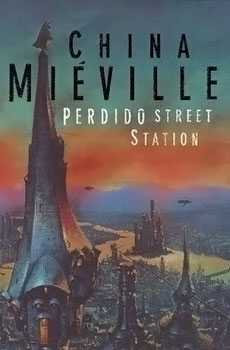
It wasn't until around 2001 that I finally got serious about fantasy fiction. Another way to put that is that I read Tolkien's The Lord of the Rings. What can I say about the greatest fantasy novel of all-time? Its greatness helped lead me to other great authors. I discovered George R.R. Martin shortly thereafter and have spent most of my life since then waiting for the next book...and the next...and the next. In the meantime, I devoured all of China Mieville's New Crobuzon novels. The irony of this wasn't lost on me: Mieville stands in opposition to Tolkien, both politically and stylistically. But, of course, like all fantasy authors, he owes the Great One everything, whether he likes it or not. I embraced the weirdness of Mieville's world, even when it was hard to picture it in my head.

Sometimes a fella needs some derring-do. I found it in the work of a pair of authors. Scott Lynch's The Lies of Locke Lamora is so wickedly funny and brash that I found I couldn't read it in public without drawing undo attention to myself. Meanwhile, Patrick Rothfuss' The Name of the Wind and its sequel both kept me enthralled until the last page. Rothfuss' Kvothe and Lynch's Locke Lamora are two of the most raucously enjoyable characters ever created. We learn the adventurous history of each, from childhood on up, and we enjoy every second.
And then there was the dark, gritty fantasy of Glen Cook and Joe Abercrombie. Cook's Black Company novels paved the way for a generation of GrimDark fantasy novelists. Cook showed how villains could become heroes and heroes weren't as heroic as you might think. His "everyman" hero Croaker, physician and eventually Captain of the Black Company, strikes the reader as the kind of guy that might be willing to hang out with you. Cook's writing is of a high quality, the stories are entrancing, and the characters become real people. Unlike some series, the grand finale was well worth it.
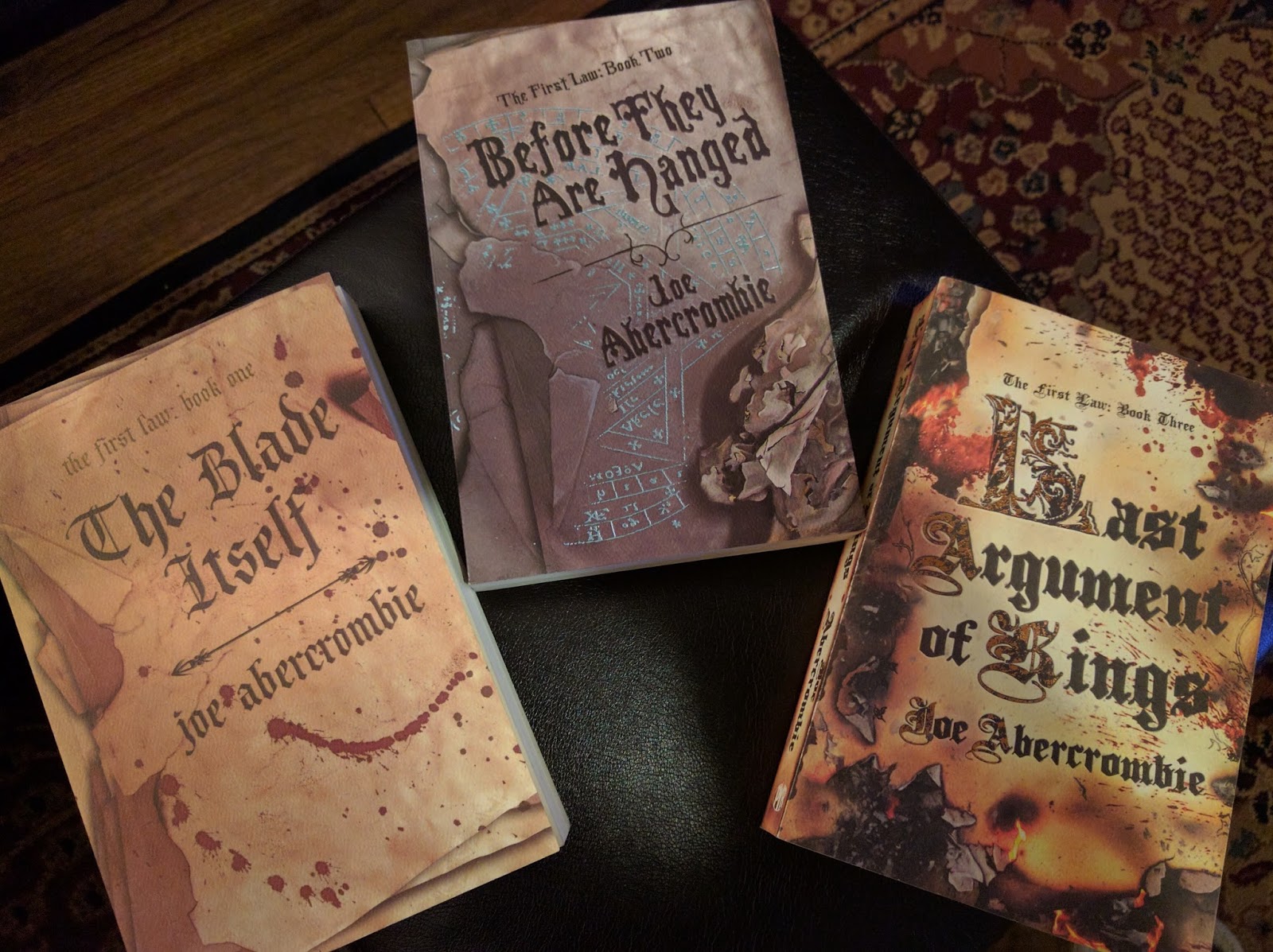
Abercrombie's First Law Trilogy takes the "hero as villain" idea and puts it into overdrive. Logan "Nine-Fingers," aka The Bloody Nine, is a hero...or is he? The wizard Bayaz is trying to save the world, right? Or is he just a greedy old conniver? The trilogy is followed by three stand-alone novels set in the same world, with appearances by many familiar faces. I reveled in all of them.
It's hard to do justice to the many books that have impacted my life over the years. The emotional impact of a book can often depend on at what point in your life you are reading it. The kinds of things that affect me certainly have changed over the years. But what hasn't changed is the need for a well-told story. No matter how precise the writing, or how fascinating the people inside the pages, it all depends on what the author does with those people. The truth is that a reader falls in love with a book...or he does not. He grows wistful at the end of a series...or he does not. He embraces the characters' humanity...or he does not. When I look at the books I have discussed on this blog, I see many different styles, themes, moods, and characters. Some of these books are character-driven accompanied by an intriguing plot...and some of them are plot-driven accompanied by intriguing characters. But they all took hold of my emotions and moved them this way and that. Like many readers I can sometimes be guilty of preferring these fictional characters to real human beings...these outlandish plots to the plot of my own life. But that kind of escapism is okay as long as you do not retreat into it completely. There is a real world out there to discover as well. Fiction can help you understand it, even if you don't accept it.
Wednesday, November 23, 2016
A Fictional Life: Part II - The Thirties in My Twenties
Click here for Part I
I wouldn't say that all my reading in high school was of a lesser quality. I can thank Mrs. Goodpasture for that. The Odyssey, The Illiad, and Dante's Inferno all had a positive impact on me. Romeo and Juliet intrigued me, but Hamlet made me appreciate the Bard. Hiroshima and The Good Earth took me to Asia and back again. A Farewell to Arms led to my bidding farewell to reading any more Hemingway. Perhaps I should give that dead bastard another chance. Twenty-five years is probably too long to hold a grudge.
If you are a reader then you know that there are moments in your life when you discover a piece of fiction that impacts you in such a way that it affects your reading life going forward. I had such a moment at the University of Kansas, thanks to a graduate teaching assistant. [As an aside, I must say that I had a series of fantastic English GTA's at KU that were just as good as any tenured professor.] I couldn't tell you that GTA's name, but she assigned the class Graham Greene's The Power and the Glory.
Greene's "whiskey priest" traveled across 1930s Mexico performing his priestly duties despite the government having outlawed the Catholic religion. As I read this book, I not only became enthralled with the story, but began to experience a religious awakening that was quite unexpected. How funny that it took a Catholic communist writer to connect me closer to my Protestant religion! After finishing this book, I began to tear through Greene's oeuvre. I would read 16 of Greene's novels while in my 20s. I particularly enjoyed The Heart of the Matter and A Burnt-Out Case, both of which featuring an Englishman living in Africa. My fascination with the idea of the white man out of place in Africa would lead me to a number of non-fiction travel memoirs featuring that theme. One book always leads to another. Eventually, as I made my way through Greene, I found his communism to become more and more obnoxious and untenable. His later books were particularly infused with Marxist claptrap. It was sad ending to such a distinguished writing life.
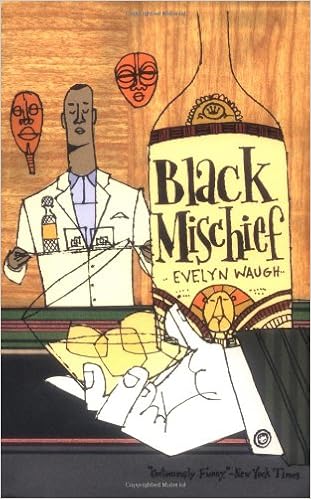
During my senior year at KU I found myself in the happy position of having fulfilled virtually all my requirements for graduation. Thus, I could search the course catalog for classes that merely piqued my interest. One such course was Fiction Writing I, with Prof. Chester Sullivan. In his course, virtually the only thing we did was write short fiction and then analyze each other's writing. It was the best class I ever took. I wrote a piece about a Pied-Noir who left Algeria for the Caribbean. I shared it with the class and Prof. Sullivan and was quite proud of myself. A couple days later, at the beginning of class, Prof. Sullivan tossed a book at me and said, "Your piece reminded me of this." It was the 1930s comedy Black Mischief by Evelyn Waugh.

Coincidentally, like Greene, Waugh too was an Anglo-Catholic. Waugh was a much better Catholic than Greene, and nothing close to a communist. His work is hilarious and I tore through it like I had done with Greene. Waugh's Brideshead Revisited showed great insight into aristocratic England, while his great WWII trilogy Sword of Honour gave the world a great character named Guy Crouchback. And one author leads to another...thanks to Evelyn's work, I discovered his older brother Alec's travel memoir Hot Countries.
Starting my senior year at KU and throughout my 20s, I began to make my way through the literary classics. Albert Camus' The Stranger and Dostoevsky's Crime and Punishment intrigued me with the view into the mind of the murderer. Joseph Conrad's Heart of Darkness fed into my fascination with Africa. Nabokov's Lolita shocked me with its portray of Humbert Humbert. I delved into black heart of Soviet communism thanks to Arthur Koestler's Darkness at Noon and Solzhenitsyn's One Day in the Life of Ivan Denisovich. I shivered thanks to James' The Turn of the Screw, and I reveled in the insanity of Kafka's The Metamorphosis.
My life in fiction would take a few more turns in my 30s and 40s...
TO BE CONTINUED...
Monday, October 17, 2016
Election 2016: How And Why It Came To This
The first campaign I remember was the 1980 Democratic primary race between Jimmy Carter and Ted Kennedy. As a five-year-old, I decided I liked Kennedy because he looked younger (ah, the innocence of youth!) By the mid-1980s, as a budding political junkie, I poured over the Wichita Eagle-Beacon every day after school. I looked forward to discussions in Mr. Stang's class about the latest edition of Weekly Reader, a schoolboy's best source for news. My subscription to the National Review began at age 14...I couldn't get enough of politics.
Every November since I turned 18, and in almost all primary campaigns in-between, I have gone to the polls to vote. But this year is like no other. I have never been more demoralized by a presidential campaign. How did this happen?
Today, confidence in institutions (the media, church, Congress, the courts, etc.) is at an all-time low. The public does not believe that the system, as it exists today, serves them. So whom does it serve? In the eyes of many Americans, it serves "The Establishment." That murky term refers to the people in power in Washington and Wall Street...people who attended the same elite universities...people who have benefited from globalization.
And then there were the OTHER people; the "less established," if you will. College students on the cusp of a working life, blue-collar workers in shrinking professions, the under-educated, the under-employed, the laid-off rejects of the new economy, the 50-something newly unemployed and now unemployable...the scared, the tired, and the bewildered. Who would speak for them? Certainly not the Establishment, with their tired calls for more free trade, a rejection of national identity, and more of the same song they've sung for so long. Forget conservatives and progressives. The establishment has some of both.
Thus, a vacuum opened...and we all know how nature feels about a vacuum. There was now a place for someone to enter who could try to appeal to these voters. Enter Bernie Sanders and Donald Trump. Each spoke to voters' desire for change, in direct opposition to the political establishment. For those "less established" on the Left, Bernie was the choice. The more conservative of these voters flocked to Trump. Trump and Sanders couldn't have seemed more different. Indeed, many of their policies were in direct conflict. Yet, each appealed to the same vague feeling that the people winning were rigging the system.
Opposite these two change agents were the Twin Establishmentarians: Jeb Bush and Hillary Clinton. Both part of America's aristocracy, these two candidates couldn't have been more a part of the national elite. Each supported free trade and globalization. Each was enthusiastic about immigration (despite Bush's protestations to the contrary). Not surprising. Their core constituencies benefited from the cheap labor...they didn't have to worry about competing for jobs with those newcomers. They certainly wouldn't have to live next door to them. The Democratic Party hitched their wagon to illegal immigration, or as they considered it, "voter importation." Their active avoidance of enforcing America's immigration laws and their embrace of illegal immigration was the height of cynicism. It may be something they later regret.
For Trump, an enormous array of Republican candidates proved to be a godsend. He was able to win primary after primary as the various Establishment candidates split the country club vote. Rubio and Bush realized much too late that they were paving the way for Donald Trump. It seemed improbable...no, it seemed IMPOSSIBLE. Who could take seriously the possibility of DONALD TRUMP winning the Republican nomination? I didn't. But the one person who did take it seriously was Donald Trump. He would have the last laugh in that primary. He would ride to victory on a wave of anger at the Establishment.
The irony of ironies was that the Democratic Party, champion of the common man, would be responsible for screwing the other populist candidate out of the nomination. The structure of the Democratic primary system, with its super delegates and their special powers, would ensure the election of Hillary Clinton. Clinton, who started her presidential campaign sometime around 1993, had managed to get the entire Democratic Establishment behind her before Bernie Sanders had time to contemplate a run. Had it been a fair race, one without super delegates, Bernie Sanders would probably have won. Hillary Clinton had been a uniquely unpopular figure until the rise of Donald Trump.
With a grating voice and the lack of a common touch, Clinton displayed none of her husband's natural political charisma. She combined that with an ambition that knew few bounds...certainly not the bounds of an ideology. She's held several. In the early '90s she was the feminist counterpoint to Bill's pragmatism. But in the span of 15 years she completely changed her image. As a senator from...New York? Illinois? Arkansas?...her only home was the place of most convenience. That applied to politics as well. Now a centrist, Hillary Clinton embraced the Great Middle of American politics. A wise choice, it seemed. But then she lost to Barack Obama. Now, a new transformation: to become a "progressive." The pressure from her Left was intense. Bernie Sanders was uncompromising...so she had to become the same.
All politicians are to some degree pragmatists first, ideologues second. But Hillary Clinton developed a reputation as an outlier on that scale. Her ambition drove everything. This led to mistakes: Libya, emails, etc. It didn't help that she developed a reputation as unpleasant to the "little people" who surrounded her. "The spineless politician with contempt for the common folk" is not a basis for any successful presidential campaign...
Unless you are facing Donald Trump. He is the personification of every '80s movie villain: the rich asshole who thinks he can get away with anything. Loud, crude, litigious, and full of shit, Donald Trump is equally as drunk with power as Hillary Clinton. But his sort of power has always been more of the celebrity-kind. Put aside the huge amounts of money and the power that brings...he always sought the kind of power that big-time celebrities brought to the table. Maybe that's why he wants to be president...who knows. Regardless, he is a first-class douchebag who has very little interesting to say about what our government ought to do.
At first, I did not understand the appeal of Donald Trump. It wasn't until I started to realize the depth of the disdain the public had for the Establishment that I began to realize what was happening: Trump was the face of a movement. That movement sought change agents. Agent Sanders failed to escape the primaries. Agent Trump successfully made his way to the general election. He will almost certainly fail...not because the public rejects change, but because they reject him. However, this thirst for demolishing the Establishment is not about to go away. The public will continue to seek agents for this change until they find the right one. As well they should. I believe our politics over the next x years will defined by this opposition to the political establishment. This means that Hillary Clinton, the candidate of war and Wall Street, may very well find herself on the wrong side of a movement that is equally as strong on the Left as it is on the Right.
What's a fella to do? For me, it's a reluctant vote for Gary Johnson, the lightweight Libertarian. Unlike many people, I do not begrudge you a vote for the Twin Disasters. I can understand why a conservative, desperately trying to avoid Obama II, votes for Trump. Democrats, I can see why you get drunk and pretend Hillary is a progressive, even though you probably aren't really fooled. Hey, you want to stop Trump. I get it. But I think you'll both regret it.
What comes after this? Maybe someone from the two parties can take this anti-Establishment movement and mold it into something electable. I see a path to this result. Perhaps I will take that up in my next post.
Every November since I turned 18, and in almost all primary campaigns in-between, I have gone to the polls to vote. But this year is like no other. I have never been more demoralized by a presidential campaign. How did this happen?
Today, confidence in institutions (the media, church, Congress, the courts, etc.) is at an all-time low. The public does not believe that the system, as it exists today, serves them. So whom does it serve? In the eyes of many Americans, it serves "The Establishment." That murky term refers to the people in power in Washington and Wall Street...people who attended the same elite universities...people who have benefited from globalization.
And then there were the OTHER people; the "less established," if you will. College students on the cusp of a working life, blue-collar workers in shrinking professions, the under-educated, the under-employed, the laid-off rejects of the new economy, the 50-something newly unemployed and now unemployable...the scared, the tired, and the bewildered. Who would speak for them? Certainly not the Establishment, with their tired calls for more free trade, a rejection of national identity, and more of the same song they've sung for so long. Forget conservatives and progressives. The establishment has some of both.
Thus, a vacuum opened...and we all know how nature feels about a vacuum. There was now a place for someone to enter who could try to appeal to these voters. Enter Bernie Sanders and Donald Trump. Each spoke to voters' desire for change, in direct opposition to the political establishment. For those "less established" on the Left, Bernie was the choice. The more conservative of these voters flocked to Trump. Trump and Sanders couldn't have seemed more different. Indeed, many of their policies were in direct conflict. Yet, each appealed to the same vague feeling that the people winning were rigging the system.
Opposite these two change agents were the Twin Establishmentarians: Jeb Bush and Hillary Clinton. Both part of America's aristocracy, these two candidates couldn't have been more a part of the national elite. Each supported free trade and globalization. Each was enthusiastic about immigration (despite Bush's protestations to the contrary). Not surprising. Their core constituencies benefited from the cheap labor...they didn't have to worry about competing for jobs with those newcomers. They certainly wouldn't have to live next door to them. The Democratic Party hitched their wagon to illegal immigration, or as they considered it, "voter importation." Their active avoidance of enforcing America's immigration laws and their embrace of illegal immigration was the height of cynicism. It may be something they later regret.
For Trump, an enormous array of Republican candidates proved to be a godsend. He was able to win primary after primary as the various Establishment candidates split the country club vote. Rubio and Bush realized much too late that they were paving the way for Donald Trump. It seemed improbable...no, it seemed IMPOSSIBLE. Who could take seriously the possibility of DONALD TRUMP winning the Republican nomination? I didn't. But the one person who did take it seriously was Donald Trump. He would have the last laugh in that primary. He would ride to victory on a wave of anger at the Establishment.
The irony of ironies was that the Democratic Party, champion of the common man, would be responsible for screwing the other populist candidate out of the nomination. The structure of the Democratic primary system, with its super delegates and their special powers, would ensure the election of Hillary Clinton. Clinton, who started her presidential campaign sometime around 1993, had managed to get the entire Democratic Establishment behind her before Bernie Sanders had time to contemplate a run. Had it been a fair race, one without super delegates, Bernie Sanders would probably have won. Hillary Clinton had been a uniquely unpopular figure until the rise of Donald Trump.
With a grating voice and the lack of a common touch, Clinton displayed none of her husband's natural political charisma. She combined that with an ambition that knew few bounds...certainly not the bounds of an ideology. She's held several. In the early '90s she was the feminist counterpoint to Bill's pragmatism. But in the span of 15 years she completely changed her image. As a senator from...New York? Illinois? Arkansas?...her only home was the place of most convenience. That applied to politics as well. Now a centrist, Hillary Clinton embraced the Great Middle of American politics. A wise choice, it seemed. But then she lost to Barack Obama. Now, a new transformation: to become a "progressive." The pressure from her Left was intense. Bernie Sanders was uncompromising...so she had to become the same.
All politicians are to some degree pragmatists first, ideologues second. But Hillary Clinton developed a reputation as an outlier on that scale. Her ambition drove everything. This led to mistakes: Libya, emails, etc. It didn't help that she developed a reputation as unpleasant to the "little people" who surrounded her. "The spineless politician with contempt for the common folk" is not a basis for any successful presidential campaign...
Unless you are facing Donald Trump. He is the personification of every '80s movie villain: the rich asshole who thinks he can get away with anything. Loud, crude, litigious, and full of shit, Donald Trump is equally as drunk with power as Hillary Clinton. But his sort of power has always been more of the celebrity-kind. Put aside the huge amounts of money and the power that brings...he always sought the kind of power that big-time celebrities brought to the table. Maybe that's why he wants to be president...who knows. Regardless, he is a first-class douchebag who has very little interesting to say about what our government ought to do.
At first, I did not understand the appeal of Donald Trump. It wasn't until I started to realize the depth of the disdain the public had for the Establishment that I began to realize what was happening: Trump was the face of a movement. That movement sought change agents. Agent Sanders failed to escape the primaries. Agent Trump successfully made his way to the general election. He will almost certainly fail...not because the public rejects change, but because they reject him. However, this thirst for demolishing the Establishment is not about to go away. The public will continue to seek agents for this change until they find the right one. As well they should. I believe our politics over the next x years will defined by this opposition to the political establishment. This means that Hillary Clinton, the candidate of war and Wall Street, may very well find herself on the wrong side of a movement that is equally as strong on the Left as it is on the Right.
What's a fella to do? For me, it's a reluctant vote for Gary Johnson, the lightweight Libertarian. Unlike many people, I do not begrudge you a vote for the Twin Disasters. I can understand why a conservative, desperately trying to avoid Obama II, votes for Trump. Democrats, I can see why you get drunk and pretend Hillary is a progressive, even though you probably aren't really fooled. Hey, you want to stop Trump. I get it. But I think you'll both regret it.
What comes after this? Maybe someone from the two parties can take this anti-Establishment movement and mold it into something electable. I see a path to this result. Perhaps I will take that up in my next post.
Tuesday, June 28, 2016
How To Write a Wichita Wings Book In 3,295 Easy Steps
Twice, I've ALMOST written a book. Both were quite good...in theory. One was a fantasy novel; the other a satirical novel on politics. I wrote about 35 pages of the former and roughly zero pages of the latter (oh, but the concept was beautiful!) Thus, I should have had some trepidation when deciding to write a book about Roy Turner and the Wichita Wings. If I didn't come through in the end, I wouldn't just disappoint myself this time.
Somewhere around 2010, Mike Romalis and I sat in my living room watching an old Wings game tape he had transferred to DVD. It wasn't the first time we had done this. Each time I made only one request: "Don't tell me who's gonna win." This particular time, I remember turning to Mike and saying, "Do you think the Wings could ever come back?" I had no idea how prescient these words would be. A few months later, Wink Hartman announced that the Wings would return to Wichita. Soon after, I was pitching a story to Splurge! Magazine about just that. The article I wrote would begin a circuitous path that eventually led to Make This Town Big: The Story of Roy Turner and the Wichita Wings.
A few paragraphs ago, I mentioned the 1979-85 Eagle-Beacon articles that Mike had painstakingly copied. We got to a point in our research when we knew we'd need more material from 1986-1992. It looked like Mike would need to go back to the library. This is where fate interceded. I got a call from Johnny Freedom. He had acquired a set of yearbooks that an unknown Wings fan had put together. This wonderful fan had glued Eagle articles in the yearbooks...from 1985-1990. Talk about saving the day!
I began writing the actual text of the book before we had finished the interviews or the research. This was possible because we had done most of the interviews in chronological order...i.e. we interviewed Kenny Cooper and Roy's other friends from the Dallas Tornado prior to our interviews with many of the Wings. So I began writing when the earlier research was mostly complete. This meant that I was researching, organizing, transcribing, and writing all at the same time.
I finished writing the book a year and three months after that meeting with Roy Turner and Kim Roentved at Deano's. At that point, I had to turn a Google Doc into a book. Mike and I considered trying to find a traditional publisher. However, these days, if you want to publish a book it's easier to self-publish. The biggest advantage of self-publishing is you'll retain more control over your book. I chose CreateSpace, which is the largest self-publishing company in the world. Owned by Amazon.com, CreateSpace gave us easy access to online selling and put out a product that looked just like any book from a traditional publisher. We had to pay CreateSpace a significant amount of money to format our text into a slick-looking trade paperback with a glossy cover and an interior with the right dimensions and font. A little bit more money to CreateSpace gave us a Kindle version as well. My overall experience working with CreateSpace was positive. When I write my next book I'll likely use them again. Thanks to our Go Fund Me campaign, Mike and I will not lose money on this book. We might even make a little bit of money. For that, we are grateful.
I used to tell people that "I don't like to write, I like to have written." In the case of this book, the process was difficult, but it was so educational and interesting that it was almost as important to my life as the finished product. I'm proud of what Mike and I created. I'm happy that so many people were able to have their voices heard in our text...and that the story of Roy Turner and the Wings is receiving the attention it so justly deserves. Go Wings!
Before the book came the indoor soccer obsession. For Mike, that happened in the 1980s. But for me it began with the new Wings squad. Through Facebook (where else?) I met Anthony Villegas, David Weber, and other rabid fans. I bought season tickets and would attend every single home game of the Wichita Wings and Wichita B-52s over the next four years. I was hooked.
In January of 2015, my fellow Futbol Wichita Live board member, Johnny Freedom, approached me about writing a book on the long and storied history of Roy Turner and the Wichita Wings. To be honest, I don't remember my exact reaction to this idea. I vaguely recall being positively disposed, sprinkled with a dash of fear. I went to Mike and told him about the plan. He himself had thought about writing this book, but it had never quite come to fruition. Instead, he had concentrated on building a now defunct website devoted to the Wings. But sitting in Mike's apartment that evening, we agreed to write the book together, as equal partners.
Days later, Futbol Wichita Live founder Josh Kippenberger set up a meeting at Deano's sports bar with Roy Turner and Kim Roentved. I had met both men, but didn't know either very well. It was a bit surreal...speaking with these two soccer legends, telling them that we wanted to write this book about them and their experiences. But it was immediately clear that they wanted to tell their story and believed the tale of the Wings was worth telling. I didn't yet fathom how great a story it truly was.
Not too long afterwards, Johnny Freedom and I went over to Roy's house and conducted the first interview. I was a bit nervous because...well, I'd never done this before and was making it up as I went along. Johnny was filling in for Mike, who would join me for virtually every other interview we would conduct over the course of researching the book. Mike and I would interview 40 people for a total of about 45-50 total interviews. Our interviews with Roy Turner, Kevin Kewley, and Kim Roentved were in person. Though some were done individually, we found that the group interviews with those three gentlemen were particularly useful because they would feed off each other's answers, providing us with an effective interplay of comments. Plus, when talking about events that happened 30-40 years ago, it helps to have someone else there who remembers it and can therefore spark the others' memories. Roy really paved the way for this book to be a success. If he hadn't been so helpful (from getting us in touch with players to giving so much of his time for interviews) this book wouldn't have succeeded.
At first, I used an app on my phone to record the interviews. This proved to be a mistake. The quality was less than desirable. Mike and I then invested in a voice recorder that I could plug directly into my computer to download the audio file. Most of our subsequent interviews were over the phone. We would put the phone on "speaker" and then, with the consent of the interviewees, record the conversation. The quality of the voice recorder was excellent, thus our recordings were easy to listen to (even with a few accents thrown in). The interviews themselves were usually a lot of fun and easy to conduct. Generally speaking, people want to tell their story. Though some people needed prompting, others just started talking...and didn't stop until their story was told. Both kinds of interview were productive.
Some of our subjects were discussing events that touched their lives in both joyous and painful ways. That pain was evident at times. This was particularly true of Tom Marshall and Jackie Knapp, both of whom parted ways with the Wings under less than happy circumstances. Despite the pain of dredging up those memories, it became clear to me that there was a catharsis in telling that story. The book was much better for it. Because they were so honest about their experiences, it was bound to bring them pain in the telling. But that honesty made the story fuller and richer.
We heard so many stories about how much everyone loved Andy Chapman. But I didn't really understand it until we interviewed him. We spent almost three hours on the phone with him, and by the end, I understood. Andy is a charismatic man: a unique mixture of charm and humility. His story was so honest and heartfelt that we were transfixed by it. It was an honor to record it all.
Some of our interviewees struggled to remember details about those days, so long ago. And then there was Jackie Knapp. She remembered everything...every detail about every important event. Her memories were SO important to the book...not only because of the detail, but because of the honesty. She wasn't one to gloss over uncomfortable facts. The interviews with her were so heartfelt...so raw and true. I have to admit, I have a soft spot in my heart for Jackie. She's one of the good guys.
The best thing Frank Carney ever did after buying the Wings was to bring Bill Kentling with him from Pizza Hut. He steered the ship so expertly, and then took on the impossible job of running the MISL. Besides all that, he's one hell of a comedian. If you told me you talked with Bill and he never made you laugh...you'd either be a liar or humorless. Bill believed in our project from the beginning. When I came to him for guidance, he was always there...ready and willing to help. Most importantly, the content from his interviews was absolutely invaluable. I never would have guessed that writing this book would result in real and lasting friendships, but Bill and Jackie are prime examples.
Nobody loved the Wings more than Terry Nicholl. That's the biggest takeaway from our interview with him. His love for Wichita came through so clearly when we spoke with him. He sacrificed for the team and still loves the Wings despite losing his coaching job. I think he's a real hero for the Wings. He did everything he could for them, and they were so much better for having him...on and off the pitch.
I never felt any of our interviewees were deceptive in their answers. Sure, some of them censored themselves at times; but that's to be expected from human beings. But no one was an honest as Kim Roentved. Kim told us how he really felt on every subject we brought up. It is refreshing to hear from a man who doesn't fear speaking the truth.
But what is the truth? It is, of course, unknowable, in the fullest sense. The format of our book allowed for that. We let our subjects tell their stories. The readers can judge for themselves what rings true or hollow. I very intentionally did not want to editorialize in the italicized portions of the book. In between each interviewee's passage, I purposefully added material that I felt fleshed out the details they were discussing. That structure, with the interviewee's words preceded and followed by italicized information from me, might initially be jarring to some readers. However, it made for a better book. I owe a debt of gratitude to the authors of Those Guys Have All The Fun: Inside the World of ESPN. It was from that book that I got the idea of using the oral history format for Make This Town Big. We had so many wonderful quotes from our subjects that it was a no-brainer to use those words to tell the story.
Of course, you don't have a coherent story unless you have an author to write it. But what if you have two authors? Our method was to stick to our strengths. Mike was the Wings expert. I was the writer. The book wouldn't have worked with just one of us. First off, before we even started this project, Mike had spent countless hours in the WSU and Wichita Public libraries making digital copies of every single article about the Wings in the Wichita Eagle-Beacon. He had succeeded in getting everything from 1979 to 1985. Thus, we had a treasure trove of information to use. Additionally, Mike had copies of dozens of Missile Magazine and The Wichitan magazine articles about the Wings. We developed a system for writing the book: Mike would come up with a list of important events in each season that he thought we should cover. I would use that list, the newspaper/magazine material, and our interviews to write a chapter. Then I'd send that finished chapter to Mike for his thoughts. He would then point out errors, additions, and changes that needed to be made. I agreed with his changes about 95% of the time. We won't talk about that other 5%.
But I get ahead of myself. Before I could even start writing, I had a monumental task ahead of me: transcribing 100 hours of audio interviews. If there is a Nobel Prize for transcribing...I deserve it. Each hour of audio recording takes approximately 3-4 hours to type out. That comes out to between 300-400 hours of transcribing. It. Was. Exhausting. I tried an automated program that supposedly would take the audio and type it out for you. It was trash. So I did it all manually. Though the pain of this Herculean effort (though I felt more like Sisyphus at the time) made me want to bore a hole in my skull, I gained so much from it. I knew their words backwards and forwards because I had taken part in these conversations and then typed them out, word for word. I learned A LOT. It made me a better author.
But transcribing that material was only the beginning. Once I transcribed it I then had to organize it. By the end of the transcription process I had a couple hundred single-spaced pages of material. I then divided the material into sections based on Wings seasons (i.e. 1984-85) or topics (i.e. thoughts on coaching, the Hatch Cover, summer camp stories, etc.). I waded through each interview transcript, copied the passage and then pasted it into the relevant section in another Google Doc. I would then color that passage from the transcript yellow so that I would know it had already been placed in the "Organized by Topic" Google Doc. Slowly but surely I made my way through all the transcripts until they were completely yellow. The result was two Google Docs full of organized transcription material.
I bet you didn't know that a Google Doc has a maximum number of characters. And I bet you never had to worry about reaching that maximum. For the record, it's 1 million characters. I got a little nervous towards the end of the book...I think I finished at somewhere around 950,000 characters. I wrote this entire tome on my Toshiba Chromebook, using Google Docs. That means I had to forego some of the luxuries of Microsoft Word, like automated endnotes/citations. All my citations were manually inserted. Besides that, I think you'll find that your Google Doc starts to get a little clunky after about 100 pages. In the end, the only thing I used Microsoft Word for was the editing process (which I did on a different computer). I regret nothing...not even the umpteen pages of citations in the back of the book. I decided if I was going to write this book, I wanted every source to be documented. Go big or go home. Academic writers spend a lot of time worrying about style, i.e. APA vs. MLA vs. Chicago style. Because I was writing for a general audience, and not just for academicians, I decided to bend the rules here and there. Thus, this book was written in what I call "Schaumburg, Illinois Style"...not quite Chicago, but pretty darn close.
Some of our subjects were discussing events that touched their lives in both joyous and painful ways. That pain was evident at times. This was particularly true of Tom Marshall and Jackie Knapp, both of whom parted ways with the Wings under less than happy circumstances. Despite the pain of dredging up those memories, it became clear to me that there was a catharsis in telling that story. The book was much better for it. Because they were so honest about their experiences, it was bound to bring them pain in the telling. But that honesty made the story fuller and richer.
We heard so many stories about how much everyone loved Andy Chapman. But I didn't really understand it until we interviewed him. We spent almost three hours on the phone with him, and by the end, I understood. Andy is a charismatic man: a unique mixture of charm and humility. His story was so honest and heartfelt that we were transfixed by it. It was an honor to record it all.
Some of our interviewees struggled to remember details about those days, so long ago. And then there was Jackie Knapp. She remembered everything...every detail about every important event. Her memories were SO important to the book...not only because of the detail, but because of the honesty. She wasn't one to gloss over uncomfortable facts. The interviews with her were so heartfelt...so raw and true. I have to admit, I have a soft spot in my heart for Jackie. She's one of the good guys.
The best thing Frank Carney ever did after buying the Wings was to bring Bill Kentling with him from Pizza Hut. He steered the ship so expertly, and then took on the impossible job of running the MISL. Besides all that, he's one hell of a comedian. If you told me you talked with Bill and he never made you laugh...you'd either be a liar or humorless. Bill believed in our project from the beginning. When I came to him for guidance, he was always there...ready and willing to help. Most importantly, the content from his interviews was absolutely invaluable. I never would have guessed that writing this book would result in real and lasting friendships, but Bill and Jackie are prime examples.
Nobody loved the Wings more than Terry Nicholl. That's the biggest takeaway from our interview with him. His love for Wichita came through so clearly when we spoke with him. He sacrificed for the team and still loves the Wings despite losing his coaching job. I think he's a real hero for the Wings. He did everything he could for them, and they were so much better for having him...on and off the pitch.
I never felt any of our interviewees were deceptive in their answers. Sure, some of them censored themselves at times; but that's to be expected from human beings. But no one was an honest as Kim Roentved. Kim told us how he really felt on every subject we brought up. It is refreshing to hear from a man who doesn't fear speaking the truth.
But what is the truth? It is, of course, unknowable, in the fullest sense. The format of our book allowed for that. We let our subjects tell their stories. The readers can judge for themselves what rings true or hollow. I very intentionally did not want to editorialize in the italicized portions of the book. In between each interviewee's passage, I purposefully added material that I felt fleshed out the details they were discussing. That structure, with the interviewee's words preceded and followed by italicized information from me, might initially be jarring to some readers. However, it made for a better book. I owe a debt of gratitude to the authors of Those Guys Have All The Fun: Inside the World of ESPN. It was from that book that I got the idea of using the oral history format for Make This Town Big. We had so many wonderful quotes from our subjects that it was a no-brainer to use those words to tell the story.
Of course, you don't have a coherent story unless you have an author to write it. But what if you have two authors? Our method was to stick to our strengths. Mike was the Wings expert. I was the writer. The book wouldn't have worked with just one of us. First off, before we even started this project, Mike had spent countless hours in the WSU and Wichita Public libraries making digital copies of every single article about the Wings in the Wichita Eagle-Beacon. He had succeeded in getting everything from 1979 to 1985. Thus, we had a treasure trove of information to use. Additionally, Mike had copies of dozens of Missile Magazine and The Wichitan magazine articles about the Wings. We developed a system for writing the book: Mike would come up with a list of important events in each season that he thought we should cover. I would use that list, the newspaper/magazine material, and our interviews to write a chapter. Then I'd send that finished chapter to Mike for his thoughts. He would then point out errors, additions, and changes that needed to be made. I agreed with his changes about 95% of the time. We won't talk about that other 5%.
But I get ahead of myself. Before I could even start writing, I had a monumental task ahead of me: transcribing 100 hours of audio interviews. If there is a Nobel Prize for transcribing...I deserve it. Each hour of audio recording takes approximately 3-4 hours to type out. That comes out to between 300-400 hours of transcribing. It. Was. Exhausting. I tried an automated program that supposedly would take the audio and type it out for you. It was trash. So I did it all manually. Though the pain of this Herculean effort (though I felt more like Sisyphus at the time) made me want to bore a hole in my skull, I gained so much from it. I knew their words backwards and forwards because I had taken part in these conversations and then typed them out, word for word. I learned A LOT. It made me a better author.
But transcribing that material was only the beginning. Once I transcribed it I then had to organize it. By the end of the transcription process I had a couple hundred single-spaced pages of material. I then divided the material into sections based on Wings seasons (i.e. 1984-85) or topics (i.e. thoughts on coaching, the Hatch Cover, summer camp stories, etc.). I waded through each interview transcript, copied the passage and then pasted it into the relevant section in another Google Doc. I would then color that passage from the transcript yellow so that I would know it had already been placed in the "Organized by Topic" Google Doc. Slowly but surely I made my way through all the transcripts until they were completely yellow. The result was two Google Docs full of organized transcription material.
I bet you didn't know that a Google Doc has a maximum number of characters. And I bet you never had to worry about reaching that maximum. For the record, it's 1 million characters. I got a little nervous towards the end of the book...I think I finished at somewhere around 950,000 characters. I wrote this entire tome on my Toshiba Chromebook, using Google Docs. That means I had to forego some of the luxuries of Microsoft Word, like automated endnotes/citations. All my citations were manually inserted. Besides that, I think you'll find that your Google Doc starts to get a little clunky after about 100 pages. In the end, the only thing I used Microsoft Word for was the editing process (which I did on a different computer). I regret nothing...not even the umpteen pages of citations in the back of the book. I decided if I was going to write this book, I wanted every source to be documented. Go big or go home. Academic writers spend a lot of time worrying about style, i.e. APA vs. MLA vs. Chicago style. Because I was writing for a general audience, and not just for academicians, I decided to bend the rules here and there. Thus, this book was written in what I call "Schaumburg, Illinois Style"...not quite Chicago, but pretty darn close.
A few paragraphs ago, I mentioned the 1979-85 Eagle-Beacon articles that Mike had painstakingly copied. We got to a point in our research when we knew we'd need more material from 1986-1992. It looked like Mike would need to go back to the library. This is where fate interceded. I got a call from Johnny Freedom. He had acquired a set of yearbooks that an unknown Wings fan had put together. This wonderful fan had glued Eagle articles in the yearbooks...from 1985-1990. Talk about saving the day!
I began writing the actual text of the book before we had finished the interviews or the research. This was possible because we had done most of the interviews in chronological order...i.e. we interviewed Kenny Cooper and Roy's other friends from the Dallas Tornado prior to our interviews with many of the Wings. So I began writing when the earlier research was mostly complete. This meant that I was researching, organizing, transcribing, and writing all at the same time.
I finished writing the book a year and three months after that meeting with Roy Turner and Kim Roentved at Deano's. At that point, I had to turn a Google Doc into a book. Mike and I considered trying to find a traditional publisher. However, these days, if you want to publish a book it's easier to self-publish. The biggest advantage of self-publishing is you'll retain more control over your book. I chose CreateSpace, which is the largest self-publishing company in the world. Owned by Amazon.com, CreateSpace gave us easy access to online selling and put out a product that looked just like any book from a traditional publisher. We had to pay CreateSpace a significant amount of money to format our text into a slick-looking trade paperback with a glossy cover and an interior with the right dimensions and font. A little bit more money to CreateSpace gave us a Kindle version as well. My overall experience working with CreateSpace was positive. When I write my next book I'll likely use them again. Thanks to our Go Fund Me campaign, Mike and I will not lose money on this book. We might even make a little bit of money. For that, we are grateful.
I used to tell people that "I don't like to write, I like to have written." In the case of this book, the process was difficult, but it was so educational and interesting that it was almost as important to my life as the finished product. I'm proud of what Mike and I created. I'm happy that so many people were able to have their voices heard in our text...and that the story of Roy Turner and the Wings is receiving the attention it so justly deserves. Go Wings!
Friday, May 29, 2015
A Collection of My Writing From Futbol Wichita Live...
Here are a few articles from my ongoing tenure at Futbol Wichita Live, the source for news and info on the Wichita B-52s professional indoor team and our new outdoor team, FC Wichita:
My thoughts on the return of the legendary Wichita Wings star Kim "The Rocket" Roentved...
http://www.futbolwichitalive.com/2014/12/07/rocket-powered-b52/
My highly scientific study concluding that many of the Wichita B-52s have a celebrity doppleganger...
http://www.futbolwichitalive.com/2014/12/16/wichita-b-52s-vs-celebrity-death-match-edition/
My article on the "Iron Men" of Wichita soccer...
http://www.futbolwichitalive.com/2015/02/07/decades-of-orange/
And finally, my love note to the Romanian Indoor Soccer National Team, whom I adopted during their stop in Wichita...
http://www.futbolwichitalive.com/2015/03/25/arenaworldcup/
My thoughts on the return of the legendary Wichita Wings star Kim "The Rocket" Roentved...
http://www.futbolwichitalive.com/2014/12/07/rocket-powered-b52/
My highly scientific study concluding that many of the Wichita B-52s have a celebrity doppleganger...
http://www.futbolwichitalive.com/2014/12/16/wichita-b-52s-vs-celebrity-death-match-edition/
My article on the "Iron Men" of Wichita soccer...
http://www.futbolwichitalive.com/2015/02/07/decades-of-orange/
And finally, my love note to the Romanian Indoor Soccer National Team, whom I adopted during their stop in Wichita...
http://www.futbolwichitalive.com/2015/03/25/arenaworldcup/
Thursday, January 15, 2015
And the Whiner Is...
On NPR today, film critics were discussing how there weren't enough minority nominees for the Oscars this year. I'm paraphrasing here, but one of them said something to the effect of..."If the goal is to increase diversity in acting and directing, these nominations won't help." Oh, THAT'S the goal of the Oscars?
NEWSFLASH: The goal of the Oscars is to reward excellence in film, not tick off boxes on the Diversity Chart.
I would understand this sort of argument if the Academy had shown some sort of bias towards racial or sexual minorities in recent years. However, last year's Best Picture victory of 12 Years a Slave and nomination of The Dallas Buyers Club are clear evidence to the contrary. In my humble opinion, 12 Years a Slave did not rise to the level of Best Picture winner. So, why did it win?
If there is a bias in the Academy, it is, in fact, in the opposite direction. If you make a film about the HIV epidemic, the Civil Rights movement, or the tragedy of the slave trade, you will likely be rewarded by the Academy. Good luck getting nominated for a film that casts the government regulator as the villain. Bias is inherent in all choices, including my own (yay for well-done science fiction and British people!). It's not a secret that the politics of the Academy tilts rather dramatically to the left. There's nothing wrong with this, but we should all be aware of our own biases before we make important choices. I try to discard my own political biases (no doubt unsuccessfully at times) when I select the films in my WORLD FAMOUS LIST OF BEST FILMS OF THE YEAR (COMING LATER THIS MONTH!)
I am uncomfortable with the idea that we should setting aside x number of nominations every year for certain types of people. Each nomination should be set aside for those most deserving of the award, and no one else.
NEWSFLASH: The goal of the Oscars is to reward excellence in film, not tick off boxes on the Diversity Chart.
I would understand this sort of argument if the Academy had shown some sort of bias towards racial or sexual minorities in recent years. However, last year's Best Picture victory of 12 Years a Slave and nomination of The Dallas Buyers Club are clear evidence to the contrary. In my humble opinion, 12 Years a Slave did not rise to the level of Best Picture winner. So, why did it win?
If there is a bias in the Academy, it is, in fact, in the opposite direction. If you make a film about the HIV epidemic, the Civil Rights movement, or the tragedy of the slave trade, you will likely be rewarded by the Academy. Good luck getting nominated for a film that casts the government regulator as the villain. Bias is inherent in all choices, including my own (yay for well-done science fiction and British people!). It's not a secret that the politics of the Academy tilts rather dramatically to the left. There's nothing wrong with this, but we should all be aware of our own biases before we make important choices. I try to discard my own political biases (no doubt unsuccessfully at times) when I select the films in my WORLD FAMOUS LIST OF BEST FILMS OF THE YEAR (COMING LATER THIS MONTH!)
I am uncomfortable with the idea that we should setting aside x number of nominations every year for certain types of people. Each nomination should be set aside for those most deserving of the award, and no one else.
Tuesday, November 25, 2014
A Fictional Life: Part I - Humble Beginnings
In your life, if you are a reader (and if you aren't, then shame on you), there will be novels that affect you in ways beyond just an entertaining way to pass the time. Literature CAN change lives, and for the better. There is a story embedded in every reader's reading life. It is the story of their journey through literature, or perhaps, more aptly, the story of literature's journey through their life. For some people this story is a complex and winding tale. For others, it is a simple journey along a single path. My story is the former...an odd journey that has taken me through many different genres, authors, and fads. It is a wonderful story...
In the 1970s, Folgers offered a promotion where you would receive a free copy of Treasure Island with the purchase of a 2 lb can of coffee. My dad read the book aloud to me, and it made an impression. Like all boys, I longed for an adventurous life. Jim Hawkins' fit the bill. I wondered if I could be as still as a mouse while hiding in the apple barrel, a treasonous plot unfolding a few feet away. The moral ambiguity of Long John Silver may have been a bit over my head as a young boy, but his menace was easily detectable. My reading journey had begun.
When I was in elementary school, I loved comic books. Yes, I did read actual books as well, but mostly non-fiction. But then, when I was about 13, I heard people talk about this guy named Tom Clancy. He wrote novels about the thing that most fascinated me: War. So, I acquired a copy of a book called Red Storm Rising.

The hyper-realistic, technically-correct, and riveting battle action of this book made me want to read more. This led me to other Tom Clancy books, and I devoured them all throughout junior high and high school. In fact, I became a fan of the entire techno-thriller genre. [As an aside, I should say that military techno-thriller began to die after the end of the Cold War. It is a shadow of its former self]
My other passion during my teenage years was Star Trek novels; in particular, The Lost Years by J.M. Dillard. Let me tell you, there are a lot of Star Trek novels. Some were good, some not-so-good. But it kept me reading and eventually opened the door to more substantive "speculative fiction". [I hesitate to throw around the term "more substantive" when it comes to genre fiction, since this implies that it is somehow inferior to "literary fiction", which I believe is poppycock.]
TO BE CONTINUED...
In the 1970s, Folgers offered a promotion where you would receive a free copy of Treasure Island with the purchase of a 2 lb can of coffee. My dad read the book aloud to me, and it made an impression. Like all boys, I longed for an adventurous life. Jim Hawkins' fit the bill. I wondered if I could be as still as a mouse while hiding in the apple barrel, a treasonous plot unfolding a few feet away. The moral ambiguity of Long John Silver may have been a bit over my head as a young boy, but his menace was easily detectable. My reading journey had begun.
When I was in elementary school, I loved comic books. Yes, I did read actual books as well, but mostly non-fiction. But then, when I was about 13, I heard people talk about this guy named Tom Clancy. He wrote novels about the thing that most fascinated me: War. So, I acquired a copy of a book called Red Storm Rising.
The hyper-realistic, technically-correct, and riveting battle action of this book made me want to read more. This led me to other Tom Clancy books, and I devoured them all throughout junior high and high school. In fact, I became a fan of the entire techno-thriller genre. [As an aside, I should say that military techno-thriller began to die after the end of the Cold War. It is a shadow of its former self]
My other passion during my teenage years was Star Trek novels; in particular, The Lost Years by J.M. Dillard. Let me tell you, there are a lot of Star Trek novels. Some were good, some not-so-good. But it kept me reading and eventually opened the door to more substantive "speculative fiction". [I hesitate to throw around the term "more substantive" when it comes to genre fiction, since this implies that it is somehow inferior to "literary fiction", which I believe is poppycock.]
TO BE CONTINUED...
Monday, September 15, 2014
A Toast to Brendan...
On a chilly autumn morning in 1978, something happened that changed the O’Bryhim family forever. While walking through the wilds of Cedar Lakes Village near Harry and Rock, we heard a whimpering coming from the bushes.
Much to our surprise, a semi-feral pack of border collies sprang from the foliage, leaving behind the man-cub we would name Brendan. Though still sporting a vestigial tail, we raised him as a human boy. His border collie instincts never fully went away. Just take a look at his bathroom sometime...you’ll see what I’m talking about. His loyal packmates, Pepper and Jake, keep an eye on him to this very day.
Over the course of Brendan’s life, I have conducted a scientific program to create...the perfect brother. Through a series of highly technical experiments, I have instilled a number of important life lessons in his psyche.
Life Lesson #1 - “Loyalty”...One day when Brendan was a toddler and I was about 4, I heard him crying in his bedroom. Mom was nowhere to be found (probably drinking). I knew I must stay loyal to my brother and stay with him. However, nature was calling. So, I made the right decision: I pooped in the trash can. Unfortunately, I missed. It’s harder than it looks.
Life Lesson #2 - “Adversity”...One year for Christmas, Brendan very much wanted the G.I. Joe Jeep. So when Christmas morning came, and I opened one of my presents, I was most pleasantly surprised to receive...the G.I. Joe Jeep. Brendan was less pleased. I can neither confirm nor deny whether I switched the labels. However, I will say that I enjoy playing with it to this very day.
Life Lesson #3 - “Disappointment”...For years, there have been slanderous rumors that I may have been somewhat “careless” with Brendan’s things. I may have occasionally broken a toy or 2...I may have broken the antenna on his boombox (it still worked afterwards)...but I did these things to show Brendan that with life comes disappointment. You’re welcome!
Life Lesson #4 - “Never put your guard down”...Life sometimes takes you by surprise, so you must always be prepared. So, when Brendan was 8, and we decided to go to a movie, I knew it was time to test Brendan’s reflexes. He was sitting in the backseat, and I had the garage door opener in my pocket. Soon thereafter, the rear window shattered all over my brother. Never let your guard down, Brendan.
But there is one life lesson that I couldn’t teach Brendan. That lesson he’s learned from Iris. Life Lesson #5 - Unconditional, romantic love
Brendan, thank you for becoming the perfect brother. Iris, thank you for joining our family and becoming the sister I never had.
Subscribe to:
Posts (Atom)